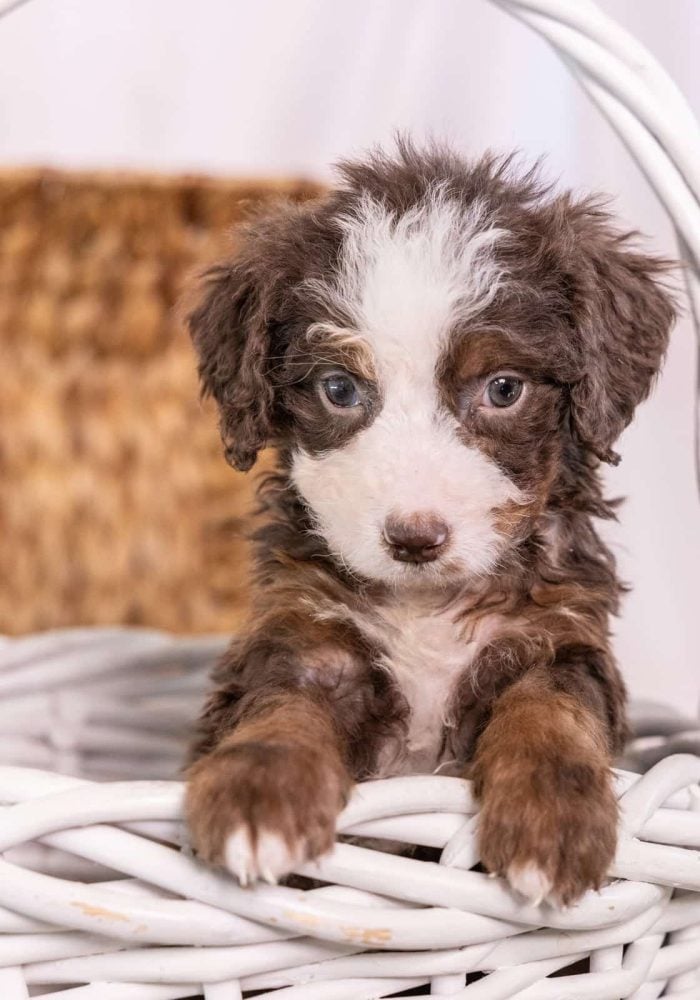
The Black and White Bernedoodle: The Iconic Tri-Color Coat
Written By Paw Tale Puppies Nov 2nd, 2026
Some coats feel like a trend. This one feels like a tradition. Black coat, crisp white chest, and a dusting of rust over the eyes and cheeks: it’s the look most people picture the second they hear the word Bernedoodle. If you’ve been searching for a black and white bernedoodle, you’re looking for the coat that started it all, and it’s still the one that turns heads at the park. Let’s talk about what’s actually in that coat, where it comes from, and what to expect as it grows.
This is the next chapter in our color-by-color series on Bernedoodle coats. We started with the merle mini bernedoodle, then dressed up in the red tuxedo. Today we’re going back to where it all began.
Navigation
Article Contents
What Is a Black Tri-Color Bernedoodle?
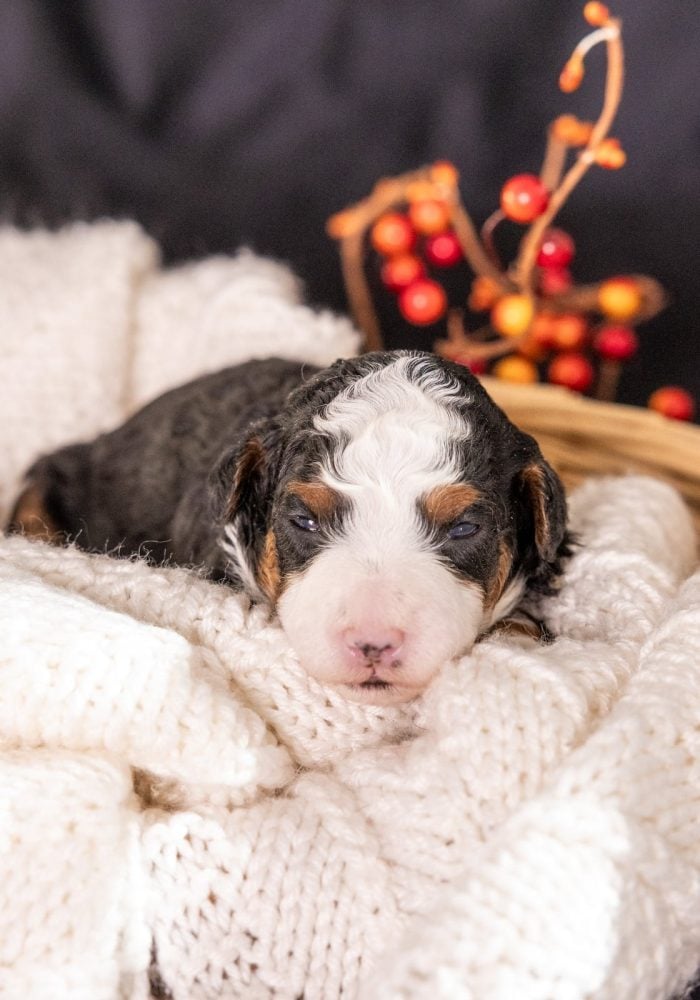
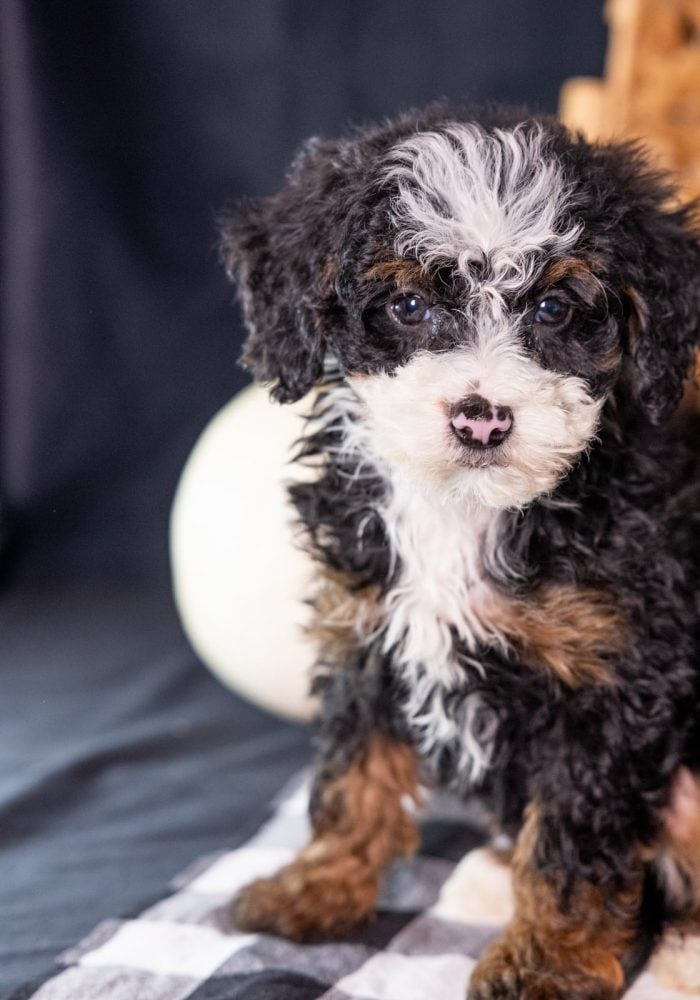
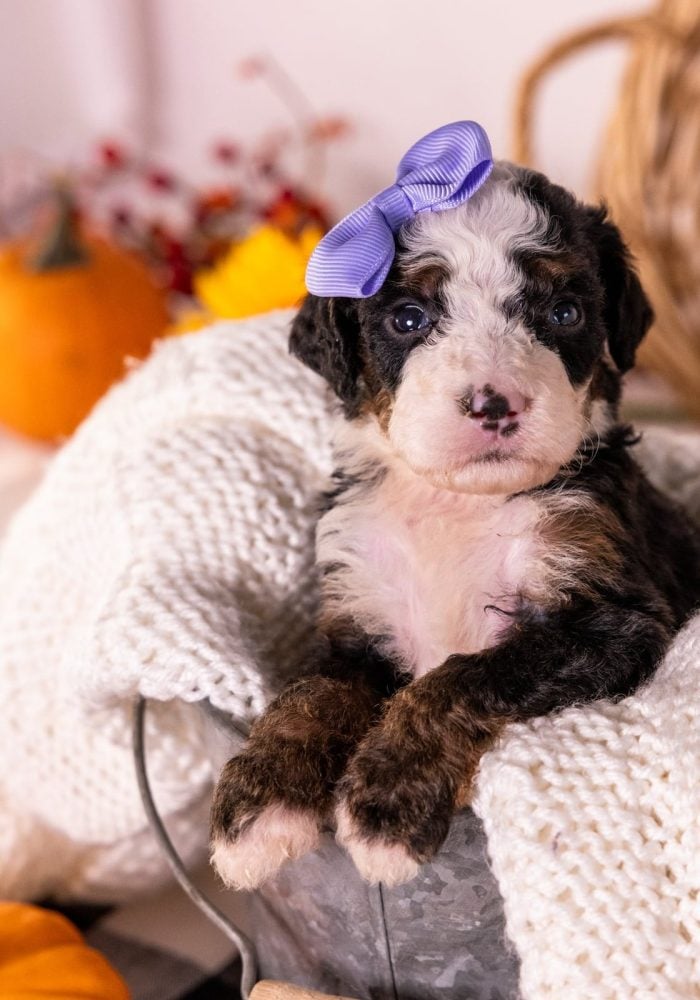
Tri-color means exactly what it sounds like: three colors. Black makes up the base coat, white shows up on the chest, paws, and often the face, and rust (sometimes called tan) sits in small points over the eyebrows, on the cheeks, and down the legs.
When people search for a black and white Bernedoodle, this is almost always the coat they mean. The rust is the part that gets overlooked. On some puppies it’s bold and warm, and on others it’s subtle enough that from across the room the dog reads as simply black and white. Look closer and the third color is usually there, tucked right where it belongs.
It’s a pattern, not a single color, and it’s laid out the same way on a Bernese Mountain Dog. The Poodle side adds the wavy or curly coat texture. The Bernese side brings the markings.
Why It's the Iconic Bernedoodle Coat
If one coat gets to be called the face of the breed, this is it. The Bernese Mountain Dog has worn black, white, and rust for generations, and when the Bernedoodle came along in the early 2000s, that tri-color look carried straight over. It’s the picture most people have in their heads long before they know anything about coat genetics, and it’s the look that helped make the whole breed a household name.
So why does a traditional coat still feel fresh? A few reasons, and honestly, they all make sense to us:
The contrast. Black and white together is about as striking as it gets, and the rust adds warmth so the coat never feels flat.
It’s a classic. A black and white Bernedoodle looks like what a Bernedoodle is supposed to look like. For a lot of families, that’s exactly the point.
No two are alike. The black stays consistent, but the white and rust land differently on every puppy. One has a full bib and tall socks, another has a single stripe down the chest.
It photographs beautifully. Dark coat, bright markings, expressive rust eyebrows. They’re built for pictures.
Tri-Color vs. Tuxedo vs. Parti vs. Phantom
These four get mixed up constantly, so here’s the quick version.
A tri-color has black, white, and rust together. A tuxedo keeps the white to the chest, paws, and sometimes the face, with no rust points at all, which makes a black tuxedo the closest thing to a true black and white Bernedoodle. A parti carries much more white, often half the coat or more. A phantom has black with rust points but little to no white.
It’s easy to see how a tri-color with very light rust and a black tuxedo can look nearly identical in photos. If you’re not sure which one you’re looking at, ask. We’re always happy to point out where the rust is hiding.
Where the Markings Come From
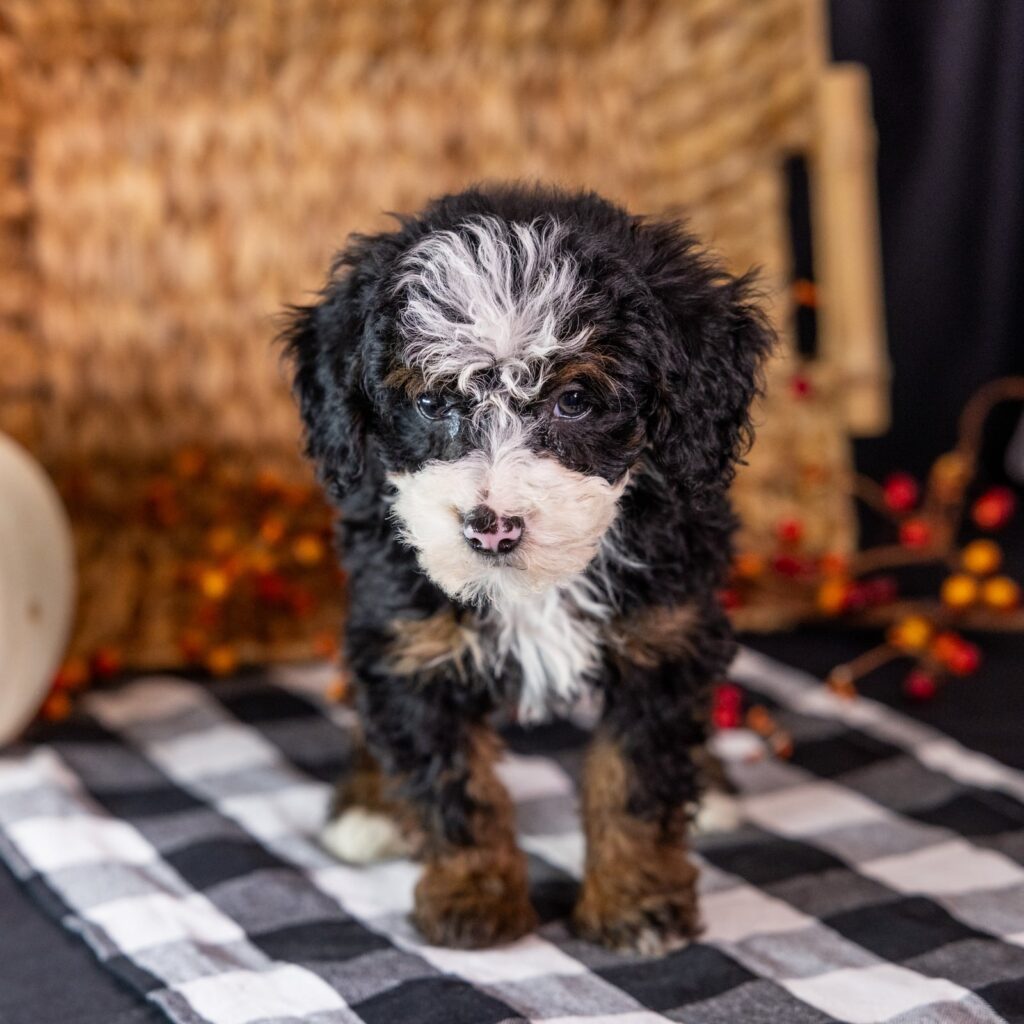

Both the white and the rust trace back to the Bernese side of the family, and each follows its own rules. Rust points are recessive, which means a puppy needs to inherit that trait from both parents to show it. That’s why you’ll see litters with a mix of full tri-colors, black tuxedos, and everything in between. How much white appears is a separate thing altogether, and it can range from a small chest patch to a full bib, socks, and a blaze.
Which version shows up depends on what each parent carries, and that’s part of why we pay as much attention to the parents as we do to the coat. If you’d like the full picture on how generations work, our micro mini bernedoodle generations page walks through it.
How the Coat Changes as They Grow
Puppy coats and adult coats aren’t always the same story. The white markings are set early, and they stay put. What tends to shift is everything around them.
As puppy fluff gives way to the adult coat, black can soften or take on a slightly lighter, smokier cast in some dogs. The rust points can deepen or mellow, and on some puppies they become easier to spot once the coat grows in. How much changes varies from dog to dog, and none of it is a flaw. It’s just the coat finishing its own sentence.
Nose and eye rim pigment can vary too, so a black and white Bernedoodle with slightly different features than the puppy in your photos isn’t a mistake. It’s genetics being genetics.
Does Coat Color Affect Temperament or Health?
Not on its own. Color and pattern are cosmetic, and they’re handled by completely different genes than the ones that shape personality. A black tri-color puppy carries the same blend of Bernese warmth and Poodle intelligence as its littermates, whatever color they are.
The same goes for health. Color doesn’t tell you anything about it, which is why we keep our focus on the parents rather than the coat. Health testing is an ongoing process for us, and it includes OFA testing on our breeding dogs. We’d rather you ask about that than about the color.
The Variations of the Black Tri-Color
Even inside one classic coat, there’s a lot of range. Here’s what we typically see:
Classic Tri-Color: a black coat with a white chest, white paws, and clear rust points over the eyes, cheeks, and legs. The look most people picture first.
Blaze Tri-Color: the same classic coat with a white stripe running up the face between the eyes.
Socks and Bib Tri-Color: a full white bib with tall white socks, the most dressed-up version of the pattern.
Light-Rust Tri-Color: a black and white Bernedoodle with softer, subtler rust points that you only notice up close.
Black Tuxedo: black with white markings and no rust points at all. The closest match to a true black and white coat.
Every one of these can turn up in the same litter, depending on what each parent carries. You don’t fully know what you’ve got until the coat starts to come in.
A Coat With a Story Behind It
That’s the tale of the black tri-color. It’s the original look, and it’s still one of the best, which is a pretty good case for tradition. Next up in this series we’ll keep working through the Bernedoodle color families, starting with chocolate, and when we’ve covered them all, we’ll pull everything into one master guide.
If the classic black and white Bernedoodle look has caught your eye, take a look at our Micro Mini Bernedoodle puppies or meet our Bernedoodle parents. You’re always welcome to reach out with questions about what a specific litter might look like.
FAQs About Black and White Bernedoodles
Is a black and white Bernedoodle the same as a tri-color? Usually, yes. Most black and white Bernedoodles are tri-colors, meaning black, white, and rust. A true black and white coat with no rust is called a black tuxedo.
What’s the difference between a tri-color and a parti Bernedoodle? The amount of white. A tri-color keeps white to the chest, paws, and sometimes the face, while a parti carries much more, often half the coat or more.
Will my tri-color’s coat change as it grows? The white markings stay. The black can soften and the rust points can lighten or deepen as the adult coat comes in. How much varies from dog to dog.
Is the black and white Bernedoodle a rare coat? No. It’s the classic Bernedoodle look and one of the most common, though the exact amount of white and rust makes every puppy a little different.
Does coat color tell you anything about health? No. That’s why we put our attention on the parents and on ongoing health testing, including OFA testing, rather than on the color.
Written By: Paw Tale Puppies
Paw Tale Puppies brings years of dedicated experience in raising happy, healthy companion dogs. With a deep commitment to responsible breeding, they prioritize ethical practices, early socialization, and attentive care from day one. Their goal is to ensure each puppy is not only well-prepared for life in a loving home but also thoughtfully matched with the perfect family, creating lasting bonds built on trust and companionship.